
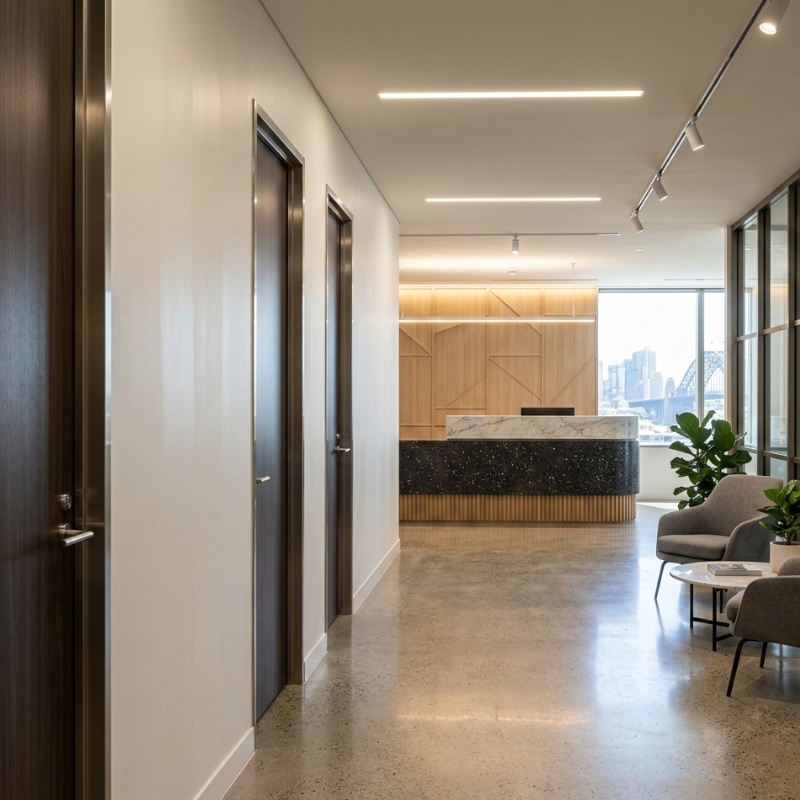
In high-traffic commercial interiors, commercial painting decisions around the finish (sheen level) often matter more day-to-day than the colour. The wrong finish can turn into constant touch-ups, visible scuffing, shiny “cleaning patches”, or distracting glare under bright LEDs and Sydney’s natural light. The right finish can keep walls looking sharper for longer, with easier cleaning and fewer obvious marks.
This guide helps you choose finishes that suit how your space is actually used: corridors, reception areas, offices, retail floors, staff kitchens, and wet zones.
The four questions that decide the right finish
Before picking matte, low sheen, satin or semi-gloss, answer these for each zone:
• How much contact will the wall get? (hands, bags, chairs, trolleys, stock movement)
• How often will it be cleaned, and with what? (microfibre vs abrasive pads; mild cleaner vs strong chemicals)
• What does the lighting do? (glazing, downlights, shopfront lighting, polished floors)
• How perfect are the walls right now? (patching, ripples, old touch-ups, texture differences)
Q: Why does sheen matter so much in busy workplaces?
Because sheen affects both visibility and maintenance. Higher sheen generally cleans more easily and resists marking better, but it reflects more light (glare) and shows defects. Lower sheen hides flaws and reduces glare, but can mark and burnish with repeated cleaning.
Paint finishes in plain English (what you gain and what you trade off)
Matte/flat
Best for: hiding surface imperfections and reducing glare
Trade-offs: scuffs show more; frequent wiping can create shiny patches (burnishing)
Matte suits low-contact spaces or feature walls where glare is a problem. It’s rarely ideal for areas that get daily cleaning or constant contact.
Low sheen (often similar to “eggshell”)
Best for: most general commercial wall areas
Trade-offs: can still burnish with aggressive cleaning; impact zones may scuff
Low sheen is the go-to “balanced” finish: softer look than satin, less glare, and more washable than true matte.
Satin
Best for: high-traffic walls that need frequent wipe-downs
Trade-offs: more reflective; can highlight patchiness or application marks under strong light
Satin often performs better in corridors, lobbies, and retail areas where cleaning is frequent.
Semi-gloss
Best for: doors, frames, skirting, trims, joinery, high-touch surfaces
Trade-offs: too reflective for most broad walls; shows every bump and patch
Semi-gloss is usually a trim/door finish in commercial interiors because it’s highly wipeable and handles constant handling.
Q: Is “shinier” always more durable?
Not always. Higher sheen often cleans easier, but durability still depends on correct prep, the right system for the substrate, and consistent application. A high sheen finish can look worse (and “fail” aesthetically) if walls are imperfect or lighting is harsh.
Space-by-space recommendations for Sydney commercial interiors
Instead of choosing one finish for the entire tenancy, zone it. A small amount of zoning reduces maintenance headaches and improves consistency.
Corridors, hallways and circulation routes
These are scuff magnets: corners, narrow walkways, lift lobbies, and entry runs.
Good starting point:
• Low sheen for moderate traffic
• Satin for heavy traffic and frequent cleaning
• Semi-gloss for doors and trims
If your corridor is strongly sunlit or has bright downlights, test a sample area first. Satin can look streaky if the wall has patchy repairs or if light rakes across it.
Reception areas and waiting rooms
Reception walls take contact from people leaning, bags, prams, and the occasional suitcase wheel.
Good starting point:
• Low sheen on most walls
• Satin in “impact zones” (behind seating, near entry doors)
• Semi-gloss on trims and doors
Open-plan offices
Offices often prioritise visual comfort. Too much sheen can add glare and make walls feel “busy”, especially with glass and LEDs.
Good starting point:
• Low sheen on broad walls
• Matte for feature walls where glare must be minimised
• Semi-gloss on doors and trims
Q: What finish reduces glare in bright offices?
Matte and low sheen usually reduce glare compared with satin and semi-gloss. If you need more washability, low sheen is often the practical compromise.
Meeting rooms and training spaces
These spaces get fingerprints around switches, AV zones, and whiteboard areas.
Good starting point:
• Low sheen walls
• Semi-gloss doors and trims
• Satin only where frequent cleaning is expected (high-touch walls)
Retail interiors
Retail is tough: constant touch, stock movement, frequent cleaning, and harsh directional lighting.
Good starting point:
• Satin for walls that need regular wipe-downs
• Low sheen or matte for large feature walls under strong spot lighting
• Semi-gloss for joinery, trims, doors
Tip: Lighting changes the “look” of sheen dramatically. A wall that looks fine in the morning can look patchy in late afternoon light—especially near shopfront glazing.
Staff kitchens, break areas and lunchrooms
Steam, splashes, and enthusiastic wiping are common here.
Good starting point:
• Satin on walls
• Semi-gloss on doors and trims
• Consider a dedicated surface for heavy splash zones rather than relying on paint alone
Wet areas (bathrooms, changerooms)
Moisture and ventilation matter as much as finish. If a wet area stays damp, paint alone won’t fix it.
Good starting point:
• Satin on walls
• Semi-gloss on doors and trims
• Avoid matte in damp, frequently cleaned areas
For a broader context on ventilation and indoor air, you can refer to the ABCB indoor air quality handbook.
Q: What finish should I use in commercial bathrooms?
Satin is a common choice for wet-area walls, with semi-gloss on doors and trims. More importantly, address moisture sources and ventilation so the surface can dry properly between cleaning cycles.
The “hidden” factors that make a finish succeed
Cleaning technique (the most overlooked factor)
Many “paint doesn’t last” complaints are actually cleaning-method problems.
What causes visible damage fast:
• abrasive pads that scratch or polish the surface
• strong chemicals that leave residue or dull the finish
• spot-cleaning only one patch, creating uneven sheen
Better approach:
• microfibre cloth + mild cleaner first
• Rinse and dry after spot cleaning
• standardise cleaning across whole wall sections where possible
Q: Why do walls get shiny patches after cleaning?
That’s often burnishing: friction changes the surface, especially with matte and low sheen finishes. Satin and semi-gloss generally resist burnishing better.
Touch-ups (choose a finish that won’t “flash”)
In busy spaces, touch-ups happen. Some finishes make touch-ups more obvious, especially if surrounding areas have been cleaned unevenly.
Practical tip: When possible, touch up corner-to-corner (a full wall section) rather than a small spot.
Wall condition and prep
A higher sheen will highlight bumps, ripples, patching, and old “paint edges”. If walls are imperfect, low sheen can look more consistent than satin.
If you’re seeing peeling, bubbling, water staining, or powdery surfaces, the issue is likely substrate-related, not simply finish selection.
A simple decision guide you can use today
If you want a fast, sensible starting point:
• Broad office walls: low sheen
• Feature wall where glare matters: matte or low sheen
• High-traffic corridors and common areas: satin (or low sheen if glare is a big concern)
• Wet areas and staff kitchens: satin
• Doors, frames, skirting, trims: semi-gloss
If you’re mapping finishes across multiple zones, it can help to think through the practical constraints of busy sites (access, traffic, cleaning, and wear patterns). A reference point like commercial painting for offices and retail, can help frame that planning.
When it’s not really a “finish problem”
If issues keep returning quickly, the finish choice might be secondary to the underlying cause:
• marks reappear immediately: high contact + wrong cleaning method
• paint rubs off to old layers: adhesion issue
• recurring mould: moisture/ventilation problem
• repeated staining: needs sealing or a different coating system
If your site needs better wear performance across corridors, lobbies, and high-touch walls, getting help with durable coatings for busy interiors is often about matching the full system (prep + primer + topcoat) to the substrate, not just changing sheen.
FAQ: paint finishes for high-traffic commercial interiors
What’s the best paint finish for high-traffic commercial walls?
Low sheen is often the best balance for most commercial walls. For heavier traffic and frequent cleaning, satin usually performs better—especially in corridors and impact zones.
Is satin or low sheen better for office corridors?
If corridors are cleaned often and show scuffs, satin is typically better. If glare and wall imperfections are the bigger issue, low sheen can look more consistent while still being reasonably washable.
Which finish is easiest to clean without leaving marks?
Satin and semi-gloss are generally easiest to wipe clean. Semi-gloss is usually best on doors and trims; satin works well for high-use wall areas.
Does semi-gloss show wall imperfections?
Yes. Semi-gloss reflects more light and will highlight patching and texture differences. It’s usually better for trims and doors rather than broad wall surfaces.
Can I use matte paint in a busy workplace?
You can, but it’s best limited to low-contact areas or feature walls where glare is a concern. In high-touch zones, matte can scuff and burnish with repeated cleaning.
What’s a safe “default” finish schedule if I’m unsure?
A common, low-risk approach is low sheen on most walls, satin in heavy-traffic corridors, and semi-gloss on doors and trims. If you want results that hold up long-term, product quality, prep and application matter just as much—often more. That’s where high-quality commercial painting systems make the difference.

