
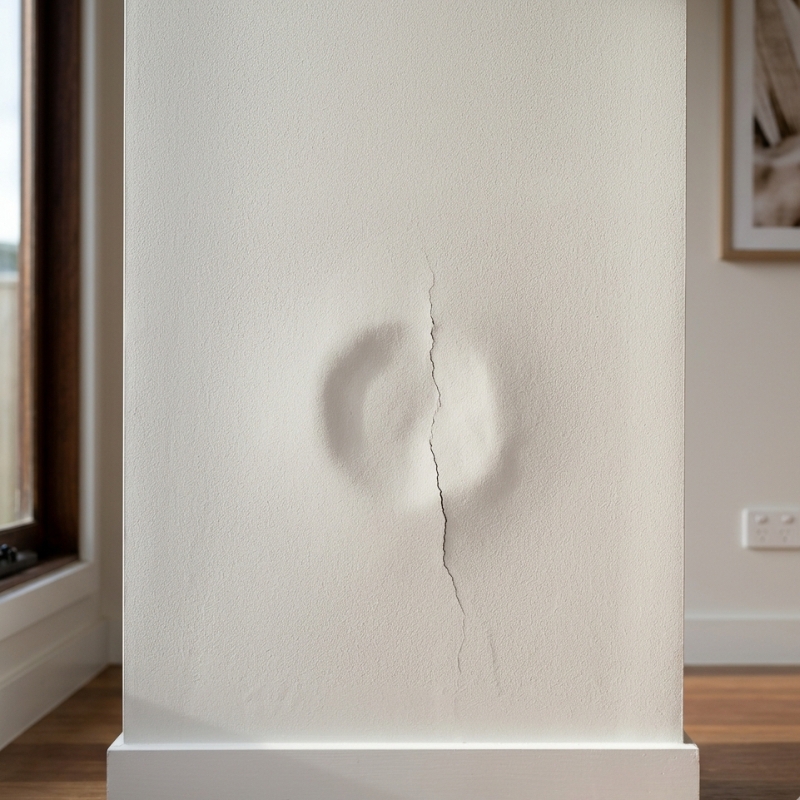
If you’ve patched a wall, painted it, stepped back feeling smug… and then noticed a fine crack, a shallow dip, or a “ghost patch” appear a few weeks later, you’re not alone. In Sydney homes, repeat patch failures are common because walls move, moisture sneaks in, products shrink, and small prep mistakes get magnified under paint and lighting—even when you feel like you’ve nailed how do you plaster a hole in the wall.
The good news: most cracking and sinking isn’t mysterious. It usually comes down to a handful of predictable causes. The even better news: once you learn how to diagnose which cause you’re dealing with, you can prevent the same repair from failing again.
This guide stays focused on the “why” and the “prevent it” side of the problem (not a step-by-step hole repair tutorial), so you can stop chasing the same crack around your home.
The quick mental model: why patches fail after they looked fine
A patch that looks perfect on day one can still fail later because the wall is a system, not a flat surface.
Most repeat failures fall into one (or more) of these buckets:
• Movement: the wall keeps shifting (settlement, framing movement, door/window stress, vibration)
• Shrinkage: the patch compound dries and contracts, leaving a dip or hairline edges
• Adhesion: the patch never bonded properly (dust, chalky paint, glossy surfaces, weak substrate)
• Moisture: dampness softens materials and breaks adhesion (leaks, rising damp, condensation)
• Finish mismatch: the patch is smooth, but the paint system reveals it (porosity, sheen, “patch flash”)
Preventing the failure is mostly about identifying which bucket applies to your wall before you patch over it again.
A practical Sydney note
Sydney’s mix of coastal humidity, temperature swings, and varied housing stock (older plaster in inner suburbs, plasterboard in newer builds, renovated hybrids everywhere) means you’ll see different failure patterns depending on the suburb and the type of wall. What works in a new apartment might not work in a 1920s terrace.
Start with diagnosis: crack, sink, or “showing through”?
Before you change products or redo the repair, work out what kind of failure you’re seeing.
If it’s cracking
Look for the pattern:
• Straight vertical/horizontal hairlines: often joint movement or shrinkage along edges
• Diagonal cracks near doors/windows: often movement around openings
• Spiderweb cracking in the patch itself: often shrinkage, over-thick fill, or drying too fast
• A crack that reopens in the same line repeatedly: usually, movement is still happening
If it’s sinking
Sinking is usually shrinkage or a patch that was built too deeply in one go. It can also be a sign that the substrate behind the patch is weak or compressible.
Common tells:
• A shallow dish in the centre of the patch
• Edges look okay, but the middle dips under side lighting
• The dip becomes more obvious a week or two after painting
If it’s “showing” after painting
The wall can be perfectly smooth and still show a patch due to:
• Different porosity between the patch and the existing paint (the patch absorbs paint differently)
• Sheen differences (low-sheen vs matt vs semi-gloss reveal unevenness)
• Lighting angles (windows and downlights make small ridges obvious)
Q&A: “How do I know if it’s the patch cracking or the wall cracking?”
If the crack runs cleanly through the patch and continues beyond it, you’re likely seeing wall movement or an underlying crack that wasn’t stabilised. If the crack is mostly within the patched area, especially with tiny edge lines or a crazed pattern, shrinkage or product/technique is more likely.
The most common causes of cracking and how to prevent them
1) The wall is still moving
Movement is the biggest reason a repair fails twice.
Common movement triggers in homes:
• Natural settlement (especially after renovations)
• Timber framing expansion/contraction with seasons
• Doors and windows flexing nearby walls
• Vibration (stairs, slamming doors, heavy traffic)
• Minor foundation movement or reactive soils in some areas
How to prevent repeat cracking when movement is involved:
• Don’t “chase the crack” with more filler alone
• Reinforce where appropriate (the goal is to bridge minor movement, not just cover it)
• If movement signs are strong, investigate the cause before cosmetic repairs
Movement warning signs that deserve extra attention:
• Cracks that widen over time
• Multiple cracks radiating from an opening
• Doors sticking or gaps changing
• Step-like cracking in masonry (if present)
If you suspect the cracking is more than cosmetic, it can be worth reading guidance from an authority on when to escalate. Building-related defect and complaint guidance varies by situation, but Building Commission NSW is a useful starting point for understanding pathways in NSW.
Q&A: “Should I patch a crack again if it reappears in the same line?”
If it reappears in the same line, assume the cause hasn’t been solved. Repatching without addressing movement usually buys you a short break, not a long-term fix. Your best next step is to work out what’s driving the movement (opening stress, framing flex, moisture, or bigger structural issues).
2) Shrinkage from the wrong product, wrong depth, or rushed drying
Most patch compounds shrink as they dry. Shrinkage becomes a problem when:
• The patch is applied too thickly in one go
• Drying is rushed (heat, strong airflow) and the surface skins over
• The wrong product is used for deep fills
• The repair is sanded/painted before it fully cures
How to prevent sinking and shrink cracks:
• Build depth gradually rather than expecting one coat to do it all
• Give repairs enough time to properly dry and cure (not just “feel dry”)
• Use the right material for the job (deep fill vs finishing)
• Avoid blasting a fresh patch with a heater to “speed it up”
Sydney-specific tip: in humid spells, patches can feel dry on the surface but still be damp underneath. Painting too soon can trap moisture and lead to soft patches, cracking, or flashing.
Q&A: “How long should I wait before sanding and painting?”
Dry times depend on product type, thickness, temperature, and humidity. A thin skim can dry quickly; a deeper fill can take much longer. If you sand and the paper clogs, or the patch feels cool/damp compared to the surrounding wall, it’s not ready. When in doubt, wait longer—especially during humid Sydney weeks.
3) Poor adhesion: the patch didn’t bond to the wall
If the repair lifts, crumbles at the edges, or cracks along the boundary, think adhesion.
Common adhesion killers:
• Dust left from sanding
• Chalky, aged paint (powdery surface)
• Glossy paint that wasn’t deglossed
• Grease or residue (kitchens, near light switches)
• Weak substrate (old plaster that’s “drummy” or flaking)
Prevention checklist for better bonding:
• Clean first (remove grease and residue)
• Remove loose or flaky material until you reach a sound substrate
• Control dust (vacuum/wipe down) before patching
• Treat chalky surfaces so the patch isn’t bonding to powder
• Make sure the wall is actually stable and sound underneath
If the wall sounds hollow when tapped (“drummy”), a patch on top can fail because the base is already detached.
Q&A: “Why did my patch crack right around the edge?”
Edge cracking often means the patch is bonded to a weak surface layer, or the edge wasn’t feathered/secured properly. It can also happen if the wall moved and the rigid patch met a flexible surrounding area. The fix is usually about surface prep and stabilising the boundary, not just adding more compound.
4) Moisture: the silent patch killer
Moisture turns many repairs into a temporary cosmetic cover.
Moisture sources to consider:
• Roof leaks (stains, swelling, recurring damp)
• Plumbing leaks (bathrooms, kitchens, laundries)
• Condensation (poor ventilation, cold corners)
• Rising damp in older homes (less common in modern plasterboard, more relevant to heritage walls)
If moisture is active, patching is like painting over a wet stain. The repair can soften, lose adhesion, discolour, or grow mould.
Prevention steps:
• Identify and fix the moisture source first
• Let the wall dry fully before repair and paint
• Consider stain-blocking/priming where staining is present (to prevent bleed-through)
Q&A: “My patch is fine, but a stain keeps coming back—why?”
Stains returning usually indicate that moisture is still present or the stain wasn’t sealed properly before repainting. Even if the patch compound is smooth, water marks and tannins can migrate through paint. Fix the source, dry the area, then use an appropriate sealing approach before topcoats.
The most common causes of patches “sinking” later (and how to stop it)
Sinking is usually a depth and shrinkage problem, but there are a few repeat patterns:
Deep fill in one go
If you fill a deep cavity in one coat, the surface can look flat at first. Then, as the centre dries and contracts, you get a shallow dish.
Prevention: Treat deep repairs as a staged build rather than a single fill.
Soft backing or unsupported areas
If the material behind the patch compresses (crumbly plaster, loose board, soft edges), your patch can settle.
Prevention: Make sure the underlying area is stable and supported before the cosmetic layer goes on.
Under-cured patch under paint
Painting before full cure can trap moisture and soften the patch. Over time, it can shrink, crack, or become more visible.
Prevention: allow proper drying time, especially in humid periods.
Q&A: “Why did the patch look level until I painted it?”
Paint can highlight a shallow dip that was already there, especially under raking light (light coming across the wall). Also, as the patch continues curing, it can shrink slightly after the first “looks dry” stage. This is why checking repairs under side lighting before painting is so valuable.
Why patches reappear after painting: patch flash and finish mismatch
A repair can be smooth but still show as a different patch because the repaired area behaves differently under paint.
Common causes:
• Porosity differences: the new patch absorbs paint differently than the old painted wall
• Sheen differences: even minor texture changes catch light
• Inadequate priming/sealing: the paint soaks in unevenly, leaving a halo
• Over-sanding edges: you create a low spot around the patch that paint reveals
Prevention strategies:
• Treat repaired areas as a different surface that often needs appropriate priming/sealing
• Check the wall in the lighting it will be seen in (daylight + downlights)
• Aim for consistent texture, not just “flat to the touch”
• Be careful feathering edges: smooth transitions matter more than chasing perfection in the centre
Q&A: “Why can I see the patch only at night?”
Downlights and lamps often create strong side lighting that exaggerates tiny ridges and dips. A patch that disappears in daytime can become obvious at night. Always inspect repairs with a torch or side light before you commit to paint.
A simple “prevent it” checklist you can run before re-patching
Use this as a decision tool to stop repeat failures:
• Is the wall dry and free from active staining or damp?
• Does the wall sound solid (no drummy/hollow areas around the repair)?
• Is the surface clean (no grease, chalk, loose paint, or heavy dust)?
• Is the underlying crack stable (not widening or reappearing in days)?
• Are you matching the repair approach to the cause (movement vs shrinkage vs adhesion)?
• Are you allowing enough dry/cure time for Sydney conditions?
• Have you checked the finish under the side lighting before painting?
If you can’t answer “yes” to the stability and moisture questions, prevention usually means addressing those first—not changing filler brands.
When to stop DIY and get a professional set of eyes
This isn’t about selling a service; it’s about avoiding endless rework (and the hidden cost of repainting).
Consider getting help if:
• A crack reopens repeatedly in the same line despite attempts to repair it
• Cracks are widening, stepping, or multiplying around openings
• The wall feels soft, hollow, or crumbly beyond the patch area
• Moisture staining persists, or the wall won’t dry properly
• You’re dealing with older plaster where sections may be detached
• You need a finish that won’t telegraph under strong lighting (feature walls, hallways, high-traffic areas)
If you’re in that camp and want a next step that aligns with this topic (repeat failures and prevention), this is the kind of situation where wall plaster repairs can be the practical solution—especially when the underlying issue isn’t just a shallow surface blemish.
Sydney scenarios: what repeat failures often look like in real homes
Scenario 1: Hairline cracks near a door frame that keep coming back
Likely cause: movement around the opening from daily use, seasonal timber movement, or a slightly stressed frame.
Prevention focus: stabilising the movement and reinforcing the repair so minor flex doesn’t reopen the line.
Scenario 2: A patch that sinks in a hallway wall after a humid week
Likely cause: deep fill shrinkage plus slow curing due to humidity, made obvious by raking light.
Prevention focus: staged build, proper dry time, and checking under side lighting before paint.
Scenario 3: A perfectly smooth patch that shows as a dull “square” after painting
Likely cause: porosity and priming mismatch (“patch flash”), especially with low-sheen paints.
Prevention focus: treating the patch as a different surface with appropriate sealing/priming and consistent finishing.
Q&A: “Is cracking always a sign of a serious problem?”
No. Many cracks are cosmetic. What matters is the pattern and behaviour over time. If cracks are stable, fine, and not growing, they’re often superficial. If they change, widen, or come with other symptoms (sticking doors, new gaps), they deserve closer attention.
FAQ
Why does my wall patch crack a month later?
Most often because the wall moved after the repair, the patch shrank as it continued curing, or the patch bonded to a dusty/chalky surface and failed along the edge. The “one month later” timing is common because movement, drying cycles, and paint curing can reveal issues gradually.
Why did my patch sink after it looked flat?
Sinking is usually shrinkage from a deep fill or a repair that wasn’t fully cured when it was sanded/painted. In humid conditions, the surface can look finished while deeper layers continue drying and contracting.
Why can I still see my patch after painting if it’s smooth?
That’s typically patch flash: the repaired area absorbs paint differently or reflects light differently due to porosity, sheen, or micro-texture differences. Priming/sealing and consistent finishing are key to stopping the “ghost patch”.
Do I need tape or reinforcement to stop cracks coming back?
If the crack is due to minor movement (especially near joints, corners, and openings), reinforcement can help bridge that movement. If the wall is actively moving or the substrate is weak, reinforcement alone won’t solve the cause—it just delays the symptom.
Can moisture cause patches to fail even if the wall feels dry?
Yes. Intermittent moisture (small leaks, condensation cycles) can soften repairs, break adhesion, and cause staining to return. If staining keeps coming back, treat it as a moisture problem first.
When should I worry that cracking isn’t cosmetic?
Be more cautious if cracks widen over time, appear as stepped cracking, cluster around doors/windows with other symptoms, or keep returning quickly after repair. In NSW, Building Commission NSW is a helpful place to understand escalation pathways if you believe a defect issue is involved.
What’s a sensible next step if the same area fails repeatedly?
Stop repeating the same patch. Diagnose whether you’re dealing with movement, moisture, adhesion, or finish mismatch. If the underlying cause isn’t obvious or the wall isn’t sound, getting advice or help can prevent a cycle of patch–sand–paint–repeat. If you need that kind of support, plastering in Sydney is a relevant next step for stubborn or recurring wall failures.

