
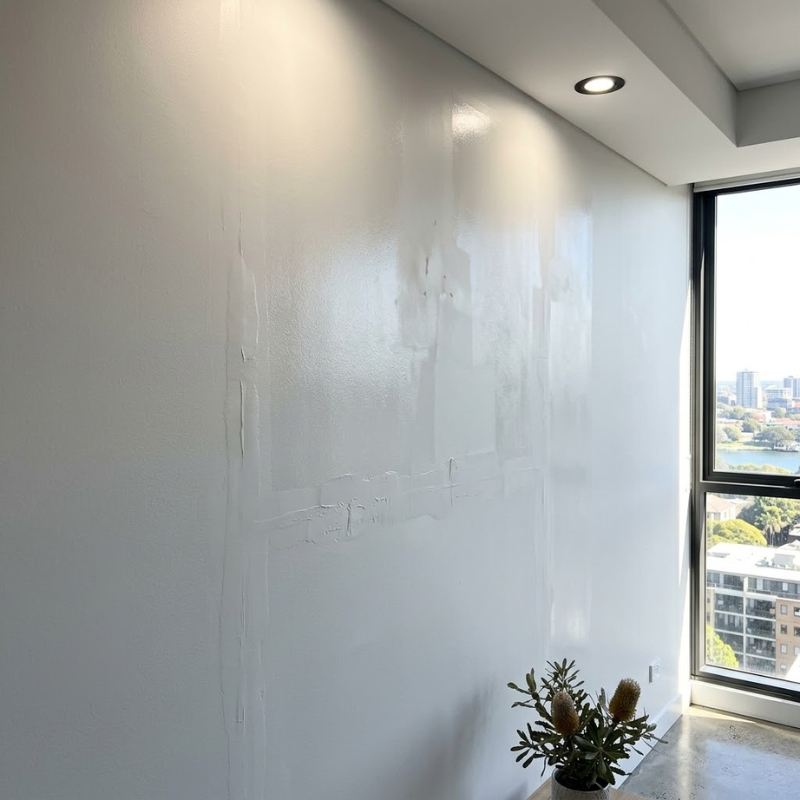
If you’ve moved into a new build (or you’re close to handover) and your walls look “fine” at night but blotchy, shiny, or patchy the moment the sun hits them, you’re not imagining things. New builds are especially prone to paint issues that only show up in certain light.
In Sydney homes, this can feel even more obvious because:
• Bright, angled sunlight is common (especially in living spaces with big glazing)
• Modern LED downlights create harsh “raking light” across walls
• Fresh plaster and rapid construction schedules can leave uneven surfaces under the final coat
The good news is that most of these issues are preventable when you understand what’s actually happening beneath the paint film.
What “new build paint issues” usually look like
Most homeowners describe the same handful of symptoms:
- Shiny patches that appear in a matte or low-sheen wall
• “Squares” or “clouds” where plaster has been patched or sanded
• Roller marks, lap marks, or bands that look like the painter stopped and started
• Touch-ups that stand out as darker, shinier, or a different texture
• Corners and joins that look different from the field of the wall
• A wall that changes appearance depending on the time of day
These problems often get lumped together as “bad paint”, but they’re typically a combination of surface condition, prep choices, and application technique.
The core cause: uneven porosity and uneven film build
Paint isn’t just colour. It’s a thin film designed to level out, dry evenly, and reflect light consistently. When the wall absorbs paint differently from one area to another, or when the paint film ends up thicker in some zones than others, you’ll see it as uneven sheen.
New builds are prime candidates for this because they contain a patchwork of materials and textures:
• Fresh plasterboard
• Joint compound at set joints
• Corners and beads
• Sanded repair areas
• Skim coats or patching from defect fixes
• Occasional mixed substrates (old-to-new transitions in extensions)
Even if everything is “painted the same colour”, the surface underneath might not be uniform enough to produce a uniform finish.
Quick answer
Flashing and patchiness in new builds usually come from inconsistent wall absorbency (especially over plaster joins and repairs) plus uneven paint application. Fixing it is rarely a small touch-up — the most reliable results come from evening out the surface first (sanding + sealing/priming), then repainting with consistent technique across the full wall.
What is paint flashing?
Paint flashing is when parts of a wall reflect light differently, so you see shiny or dull patches even though the colour is the same. It often shows up:
• Next to windows in morning/afternoon sun
• Under downlights or wall washers
• Along plasterboard joins and patched areas
• Where touch-ups have been done
It can be subtle or dramatic. In extreme cases, it looks like “maps” or “clouds” across the wall.
Q&A: Is flashing a paint defect or a prep problem?
Most of the time, it’s a prep-and-surface uniformity problem, not a faulty tin of paint. The paint is responding to differences in porosity, texture, sanding, and film thickness. That’s why two walls painted with the same product can look totally different if one has more patching or inconsistent sealing.
Why new builds are more prone than older homes
Older homes tend to have more consistent walls (for better or worse): the same aged paint, the same texture, the same history. New builds have “fresh” surfaces that haven’t stabilised, plus a higher chance of mixed textures because everything has been recently sanded, patched, and cleaned multiple times.
Common new-build-specific contributors include:
- Fresh plaster joins and stopping work: Joins can be slightly raised, slightly softer, or sanded differently
• Patching after trades: Electricians, HVAC, and cabinetry installs often lead to repairs right before painting
• Rushed timelines: If sealing/priming isn’t done properly or coats go on too fast, the finish can telegraph the substrate
• Lighting choices: New builds love bright LEDs and feature lighting that highlights wall imperfections
• Finish selection: Some finishes show everything; others are more forgiving (more on this below)
The “raking light” trap: why it looks worse in Sydney sun
Raking light is light that hits the wall at a low angle (think early/late sunlight or a downlight close to a wall). It exaggerates:
• Raised joins
• Sanding scratches
• Roller texture differences
• Any sheen inconsistency
A wall can look perfect straight-on, then look patchy when light grazes across it. This doesn’t mean you’re being picky — it means the lighting is doing what lighting does: revealing surface variation.
Q&A: Why do my walls look fine at night but terrible in the day?
At night, you often see walls in diffuse light. In daylight (especially angled sun), the wall becomes a reflective surface. Slight differences in texture and sheen become visible because the light is more directional and intense.
The most common causes (and how to recognise each one)
1) Unsealed or poorly sealed plaster repairs
Plaster and joint compound are more absorbent than the surrounding painted plasterboard paper. If repairs aren’t sealed evenly:
• The repaired areas can “drink” the paint binder
• The topcoat can dry differently over the patch
• Sheen can change, even with the same paint
Tell-tale sign: patch outlines appear as dull or shiny zones, often rectangular or oval.
2) Spot priming without blending
Spot priming repairs is often necessary — but if the primer edge isn’t feathered or the wall isn’t uniformly sealed, you can create a new problem: a visible “prime halo”.
Tell-tale sign: a ring or boundary around repairs, often seen in glancing light.
3) Touch-ups with a different roller, brush, or film thickness
Touch-ups commonly flash because the texture and thickness of the paint film change. Brushing a patch on a rolled wall leaves a different texture. Even rolling a small area can leave a different “nap” pattern.
Tell-tale sign: a patch looks like the same colour but a different sheen or texture.
4) Lap marks from losing the wet edge
Lap marks happen when one section starts drying before the next section overlaps it. This creates bands where paint layers overlap unevenly.
Tell-tale sign: vertical or horizontal bands, often more visible in low sheen and satin finishes.
5) Inconsistent sanding (or insufficient sanding)
If repairs are sanded smoother than the surrounding wall (or vice versa), paint reflects light differently.
Tell-tale sign: patches show even when the wall has been primed, especially in bright light.
6) Paint finish choice that’s too reflective for the wall condition
Higher sheen finishes reflect more, which makes defects and texture changes stand out. Very flat finishes hide more but can mark more easily in high-traffic areas.
Tell-tale sign: walls look “busy” under downlights even when colour is correct.
A simple homeowner diagnostic: what to check before you fix anything
Before you repaint, try this quick process so you don’t waste time on fixes that can’t work.
Step 1: Identify the pattern
- Random clouds or rectangles often point to repairs and porosity
• Bands often point to application technique (lap marks)
• Isolated shiny patches often point to touch-ups or film build differences
Step 2: Check it in a different light
Look at the wall:
• Morning and afternoon (if there’s natural light)
• Under downlights at night
• With blinds open vs closed
If it “disappears” in diffuse light and appears in grazing light, you’re seeing sheen/texture variation, not necessarily colour mismatch.
Step 3: Run a gentle wipe test (in an inconspicuous spot)
If you lightly wipe with a damp microfibre cloth:
• Does the sheen change?
• Does it burnish (go shiny) easily?
Some builder-grade flats mark and burnish quickly, which can mimic flashing.
Q&A: Can I just add another coat and hope it evens out?
Sometimes, but not always. If the substrate is unevenly porous (especially over patches), another topcoat can still dry differently in different areas. The best results usually come from making the surface uniform first (sanding + sealing/priming), then topcoating.
How to prevent flashing and patchiness before painting
If you’re pre-handover, building, renovating, or repainting soon, this is where you win the battle.
1) Aim for a uniform surface, not just a “smooth” one
Smoothness matters, but uniformity matters more. Two areas can be equally smooth yet reflect light differently because one is denser or more sealed than the other.
What helps:
• Feather-sanding patch edges so transitions aren’t abrupt
• Ensuring joins are finished consistently (not over-sanded in one spot)
• Removing dust thoroughly before priming
2) Use the right sealer/undercoat strategy for new plaster and repairs
For fresh plasterboard and joint compound, sealing is crucial because it controls absorbency. When absorbency is controlled, the topcoat dries more consistently, giving a more uniform sheen.
Practical tips:
• Don’t assume one quick undercoat is “enough” if there’s heavy patching
• Treat high-repair walls differently from clean, uniform walls
• Allow adequate drying time so the sealer does its job before topcoats
3) Keep your application consistent (tools, technique, and timing)
Even great products can flash if they’re applied inconsistently.
Consistency wins:
• Use the same roller nap across the entire wall
• Work to maintain a wet edge
• Avoid stopping mid-wall where possible
• Don’t stretch paint too far (thin coverage can dry unevenly)
• If cutting in, keep edges wet so you can blend
4) Choose a finish that matches the reality of the wall
If the wall is likely to have joins, repairs, or grazing light, finish selection becomes a strategic choice, not just a style choice.
As a general principle:
• Lower sheen hides more wall variation
• A higher sheen is easier to wipe but reveals more defects
• Low sheen is often a middle-ground for living areas in modern homes
If you want to understand the trade-offs room-by-room, the “finish” decision is worth treating like its own mini project — especially in new builds with strong lighting and crisp modern lines. You can also explore general guidance on interior painting finish options without turning it into a full redesign exercise.
Q&A: Will matte paint fix flashing?
Matte can reduce the appearance of flashing because it reflects less light, but it won’t fix underlying surface issues like patch edges, inconsistent sanding, or uneven sealing. Matte is a masking strategy; proper prep is the fix.
How to fix it after you’ve moved in (without chasing your tail)
Once flashing or patchiness is present, the temptation is to spot-fix. That’s also how many homeowners end up with a wall that looks worse than before.
1) Stop doing tiny touch-ups (in most cases)
Small touch-ups often create a new texture and film thickness difference. They can look fine head-on, then pop under raking light.
Better approach:
• If the issue is isolated, consider repainting a whole “section” (corner to corner)
• If it’s widespread, plan a full wall recoat with the right prep
2) Sand to level the texture transitions
If patch edges or roller texture differences are part of the problem, gentle sanding can reduce the contrast.
What you’re aiming for:
• No sharp edges between the patch and the surrounding wall
• A consistent feel across the surface
(Always dust thoroughly after sanding — dust under paint creates its own issues.)
3) Re-seal to equalise absorbency
If patches are telegraphing through, sealing is often the turning point. A uniform sealing approach (rather than spot-only) can stop the wall from absorbing differently in different zones.
4) Recoat the full wall with a consistent technique
This is where many “fix attempts” fall: the wall gets primed well, then topcoated in a way that reintroduces lap marks or uneven film build.
For best consistency:
• Maintain a wet edge
• Don’t pause mid-wall
• Roll in a consistent pattern
• Keep loading the roller evenly
Q&A: Why does repainting the whole wall work better than patching?
Because it makes the final paint film uniform in both thickness and texture. Uniform film = uniform light reflection. Patch fixes almost always leave a boundary where the film changes.
What about “defects” and expectations at handover in NSW?
If you’re assessing whether what you’re seeing is reasonable, it helps to understand how building work is commonly assessed. NSW homeowners often refer to the state’s published guidance on standards and tolerances when discussing finish quality at or after handover.
If you want a baseline reference for how building work is generally evaluated in NSW, you can read the NSW Guide to Standards and Tolerances and use it as part of your broader conversation and inspection approach.
Practical takeaway:
• Document what you see in consistent lighting
• Take photos at the same time of day
• Note whether the issue is isolated or repeated across multiple rooms
• Be clear if the problem is “visible from normal viewing positions” vs only under extreme grazing light
A prevention checklist for new build owners (Sydney-friendly)
Use this as a practical guide if you’re still in the build phase, doing a defect list, or planning a repaint after handover.
- Inspect walls in daylight and at night under downlights
• Look along walls (not straight at them) to reveal texture and joins
• Mark repeated areas (multiple walls/rooms suggest a system issue)
• Identify repaired zones (around TV points, power points, new cabinetry)
• Avoid relying on small brush touch-ups for large visible areas
• Prioritise uniform sealing where patching is heavy
• Choose finishes with lighting in mind (feature lights can be unforgiving)
• Plan repaints by wall sections so you don’t create stop-start bands
If you’re in the “new build + strong lighting + lots of crisp lines” category, it can also help to approach the finish as part of the overall new-home completion process rather than a quick cosmetic tweak. This is exactly the kind of scenario where people research interior painting for new builds to understand what creates a more consistent final look once everything has settled.
Common scenarios (and the best response)
Scenario 1: “Only the patched areas show”
Most likely: uneven sealing/porosity or sanding transitions.
Best response:
• Feather-sand transitions
• Seal uniformly (not just the patch)
• Recoat the wall for a consistent sheen
Scenario 2: “The whole wall has bands”
Most likely: lap marks from technique and drying edge.
Best response:
• Recoat with a wet-edge plan
• Work in manageable sections
• Use consistent loading and roller technique
Scenario 3: “Touch-ups are obvious”
Most likely: texture/film build difference.
Best response:
• Stop spot-touching
• Repaint corner-to-corner (or whole wall)
• Keep tools and techniques consistent
Scenario 4: “It’s only visible at 4 pm when the sun hits”
Most likely: ranking light revealing minor variation.
Best response:
• Decide whether it’s a functional issue or an aesthetic priority
• If fixing, focus on uniform surface + uniform film
• Consider the finish choice for that specific room and lighting
When it’s time to bring in a licensed professional
There’s DIY-friendly learning here, but some situations are genuinely hard to fix without experience because the solution is about system consistency, not a single product.
Consider professional help if:
• Multiple rooms show the same issue
• There’s extensive patching or re-stopping required
• You’ve already tried touch-ups, and it looks worse
• You suspect the wall needs uniform sealing and a planned recoat
• The lighting is harsh (feature LEDs, wall washers, floor-to-ceiling glazing) and you want it to look right
If you’re planning a full internal refresh after handover, it can also help to read up on preparation and scope considerations so you don’t repeat the same problems. A useful starting point is understanding what goes into interior painting in Sydney when the goal is an even, consistent finish rather than a quick cover-up.
FAQs
What causes shiny patches on matte walls in a new build?
Shiny patches are usually flashing: parts of the wall reflect light differently because the surface absorbency, texture, or paint film thickness isn’t uniform. Repairs, joins, and touch-ups are common culprits.
Why can I see plaster patches through the paint?
Patches are often more absorbent than the surrounding areas. If they aren’t sealed properly (or if the wall isn’t uniformly sealed), the topcoat dries differently over the patch and reveals the outline in certain light.
Will one more coat fix the patchiness?
Sometimes it improves, but if the underlying issue is uneven porosity or uneven texture, extra topcoats can still dry inconsistently. A better fix is usually to sand transitions, seal to equalise absorbency, then recoat.
Why do touch-ups always show on new build walls?
Touch-ups change the wall’s texture and paint film thickness. Brushed paint on a rolled wall (or a small rolled patch) reflects light differently, especially under downlights or sunlight.
Is low sheen better than matte for hiding defects?
Both can work, but a lower sheen generally hides more than a higher sheen. The “best” choice depends on lighting, wall condition, and how washable you need the wall to be.
How do I check walls properly before handover?
View them in different lighting: daylight and at night with the installed lights on. Look along the wall surface (grazing angle) to reveal joins and texture changes. Photograph repeat issues at the same time of day.
Is flashing considered a defect?
It depends on severity, visibility from normal viewing positions, and the expectations set by relevant standards/tolerances guidance. If it’s widespread or clearly visible under typical conditions, it’s worth documenting and raising.
Can harsh lighting make a normal wall look defective?
Yes. Raking light exaggerates minor texture differences and can reveal things you’d never notice in diffuse lighting. That said, good prep and uniform finishing can still dramatically reduce what you see.
)
&description=&image=https://mipainting.com.au/wp-content/uploads/2026/04/Flashing-and-Patchy-Walls-in-New-Builds-Why-It-Happens-and-How-to-Prevent-It.jpg)