
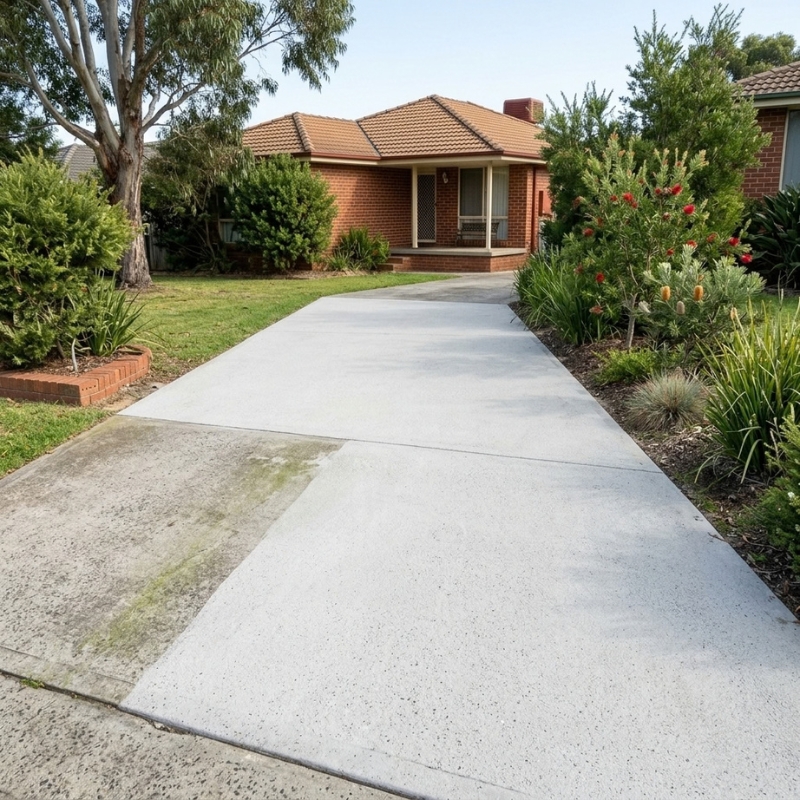
How often should you pressure clean a Sydney driveway? Most concrete driveways need it every one to two years, so for the average home it is an occasional job rather than a regular chore. What shifts that interval is the surface and the shade. MI Painting does pressure cleaning for homes and common property across Sydney, and this is one of the questions we are asked most, usually by someone whose driveway has gone green or grey and is wondering whether they left it too long. A shaded, tree-lined driveway that stays damp needs cleaning more often than an open, sunny one, so the honest answer depends on your particular driveway. This article covers the usual interval, what builds up on a Sydney driveway, when high pressure is right and when it is not, and how to make a clean last.
How often should you pressure clean a Sydney driveway? Most concrete driveways need cleaning every one to two years. Shaded or tree-lined driveways that hold moisture usually need it annually, while open, sunny driveways can often go longer without staining setting in.
How often does a concrete driveway need cleaning?
For most Sydney homes, a concrete driveway needs a proper clean every one to two years, which keeps it from building up the grime and growth that make it look tired and become slippery. That is the baseline, and it suits an average driveway in average conditions.
The big variable is how much moisture the driveway holds, and that mostly comes down to shade. A shaded or tree-lined driveway stays damp for longer after rain, and that lingering moisture is exactly what algae and mould need to establish, so these driveways usually need cleaning annually to stay on top of it. If yours sits under trees or in the shadow of the house for much of the day, assume the shorter interval. Professional pressure cleaning services in Sydney can advise on the right frequency for your driveway once they have seen the surface and its exposure.
An open, sunny driveway, by contrast, dries out quickly, which gives growth far less chance to take hold, so these can often go closer to the longer end of the range, or beyond, before staining really sets in. The driveway’s exposure is the thing to judge it by rather than the calendar alone, so look at how much sun and shade yours actually gets through the day.
What builds up on a Sydney driveway?
Understanding what actually accumulates on the surface explains both why cleaning matters and why some driveways need it sooner. A few things build up on a Sydney driveway.
Algae and mould are the shade problem. In damp, shaded areas, they grow as a green or black film that makes the surface look dirty and, more importantly, slippery when wet. This is the main reason tree-lined driveways need more frequent attention.
Oil and tyre marks come from the cars themselves: dark patches where oil has dripped, or tyres have scuffed, usually concentrated where vehicles sit and turn.
Leaf tannin staining is the one people underestimate. Wet leaves left sitting on concrete leach tannins that stain the surface a reddish brown, and this is one of the stains that sets permanently if the leaves are left long enough, so clearing leaf litter promptly matters.
Salt affects driveways near the coast, where salt-laden air settles on and works into the surface over time.
The important distinction is which of these set permanently. Algae and general grime lift readily with a clean, but leaf tannin staining and long-standing oil can become permanent if they are left, which is a strong argument for not stretching the interval too far on a driveway that collects either.
Pressure washing or soft washing: which is right?
Not every driveway should be blasted at full pressure, and knowing the difference protects your surface. There are broadly two approaches.
High-pressure washing uses the force of the water to strip grime, growth and marks off the surface, and it is the right choice on sound, modern concrete that can take it. For a solid driveway with general dirt and algae, high pressure is efficient and effective.
Soft washing, which is a lower-pressure clean that relies on a cleaning solution to do the work rather than brute force, is the safer choice on surfaces that high pressure could damage. This matters most on aged or decorative concrete, older surfaces that have started to break down, or decorative finishes like exposed aggregate, stencilled or coloured concrete, where high pressure can strip the finish, dislodge stones or etch the surface. On those, a gentler chemical clean lifts the growth and grime without harming the surface underneath.
The right method depends on what your driveway is made of and what condition it is in, which is exactly the sort of thing assessed on site rather than assumed. Getting it wrong, reaching for high pressure on a surface that needed soft washing, is how a clean turns into damage.
What can go wrong with too much pressure?
It is worth understanding what too much pressure actually does, because this is the main reason to space cleans out rather than blasting the driveway at every opportunity. Excessive pressure causes real damage.
Surface etching is the most common: the force wears into the concrete surface, leaving a rough, marked or patchy finish where the top layer has been eroded.
Exposed aggregate happens when the pressure strips the surface back far enough to dislodge the fine material and expose the stones beneath, which permanently changes how the driveway looks and feels.
Damaged jointing is another, where high pressure blows out the material in the joints between slabs or pavers, leaving gaps that then collect water and weeds.
And driven-in water is the sneaky one: too much pressure can force water down into the concrete and the joints, which over time contributes to deterioration rather than cleaning.
Because each of these is cumulative and often permanent, over-cleaning a driveway, or cleaning it too aggressively, does more harm than leaving it a little longer would. That is the real reason the interval matters: a sensible gap between properly judged cleans protects the surface, whereas frequent heavy blasting slowly wears it out.
How can you keep a driveway clean between washes?
A bit of simple upkeep stretches the time between proper cleans and stops stains setting, and none of it takes much effort. Three habits do most of the work.
Sweeping the driveway regularly clears the dirt and grit before it works into the surface and gives growth something to hold onto, so a quick sweep now and then keeps the surface cleaner for longer.
Clearing leaf litter promptly is the big one, because wet leaves left on concrete are what cause the permanent tannin staining described earlier. Getting leaves off the driveway, especially after rain and through autumn, prevents the staining before it starts.
Dealing with oil promptly matters too. A fresh oil drip is far easier to deal with than one that has had weeks to soak in, so attending to spills quickly stops them becoming the permanent dark patches that a clean struggles to shift.
None of this replaces a proper clean, but it genuinely extends the interval and keeps the worst of the permanent staining at bay, which means fewer cleans over the life of the driveway and a better-looking surface in between.
Frequently Asked Questions
How often should a driveway be cleaned?
As a general guide to driveway cleaning frequency, most concrete driveways need a proper clean every one to two years. Shaded or tree-lined driveways that stay damp usually need it annually, while open, sunny ones can often go longer, so judge it by how much shade and moisture yours gets.
When should you pressure clean concrete?
The best time to know when to pressure clean concrete is when a film of algae or grime has built up, and the surface looks dull or feels slippery, rather than on a fixed date. Catch it before leaf tannin or oil stains set in permanently, since those are far harder to remove later.
What does concrete driveway maintenance in Sydney involve?
Concrete driveway maintenance in Sydney is mostly sweeping regularly, clearing leaf litter before it stains, and dealing with oil spills promptly, plus a proper clean every one to two years. Coastal and shaded driveways need more attention, since salt and moisture both speed up the build-up.
Keeping your driveway in good shape
The sensible approach is to judge your driveway by its exposure rather than a fixed date: clean a shaded, tree-lined one annually, an open sunny one less often, keep leaf litter and oil off it in between, and have the right method matched to the surface so a clean never becomes damage. A driveway cleaned properly and on a sensible cycle stays safe and looks after itself. If you would like it assessed and cleaned the right way, or you are tidying up the exterior more broadly with exterior painting services, get in touch to talk to the team about pressure work across Sydney.

