
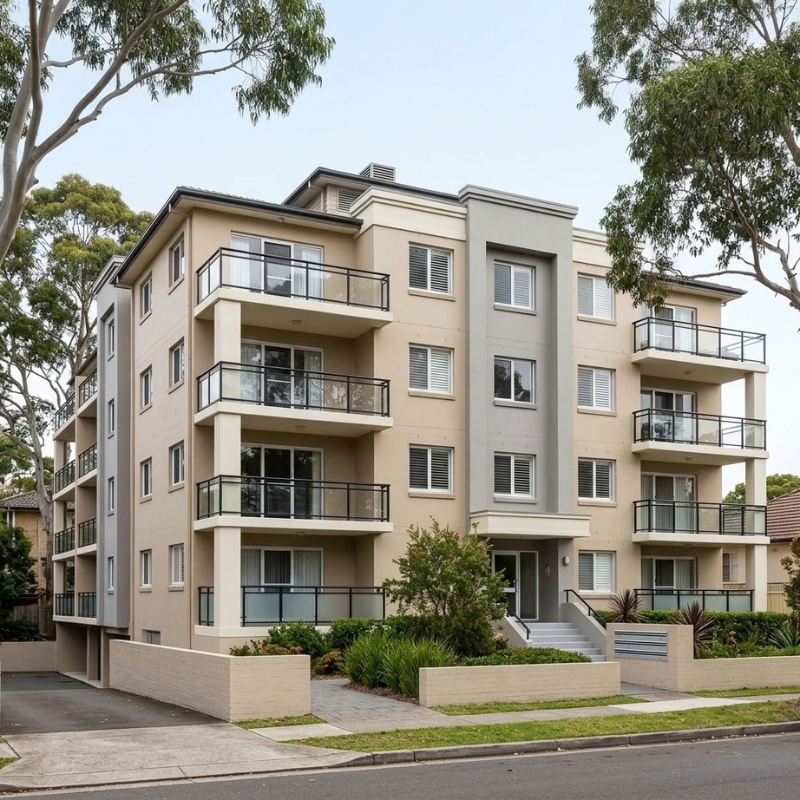
What does a strata repaint cycle look like in NSW? Common property interiors are usually repainted every seven to ten years and exteriors roughly every five to eight, so the honest answer is that there is no single fixed rule, only sensible ranges a scheme plans around. The actual timing is set by the building’s condition, not by the calendar alone. MI Painting carries out strata painting services in Sydney, and committee members and building managers ask us this all the time when they are trying to work out whether their scheme is due. This article walks through the usual cycle, what sets the timing in a NSW scheme, how a staged repaint works in practice, and the signs a building has left it too long. This is general guidance for an owners corporation, not a legal statement about any particular scheme.
What does a strata repaint cycle look like in NSW? Common property interiors are usually repainted every seven to ten years and exteriors every five to eight, with weather-exposed elements sooner. The schedule is set by the scheme’s condition reports and capital works planning, not by a fixed rule.
How often is common property typically repainted?
The repaint cycle is not one number, because different parts of a building wear at different rates, and it helps to separate them out. As a general guide, common property interiors– the corridors, stairwells and lobbies- see steady but gentle wear, much like the commercial painting services side of a building, so they are usually repainted somewhere in the range of every seven to ten years. They are protected from the weather, so the paint lasts a good while.
Exteriors come round sooner, generally every five to eight years, because the outside of a building takes a constant beating that the inside never does. Sun, rain and temperature swings all work on an exterior coating, breaking it down faster than anything indoors.
Weather-exposed elements need attention sooner still. Balustrades, exposed railings, window frames and anything on a balcony or a west-facing wall cop the harshest exposure, so they tend to need recoating ahead of the broader exterior cycle.
The reason exteriors and exposed elements lead the schedule is simply exposure: the more weather a surface sees, the faster its coating ages. These are general ranges rather than a commitment for any specific building, since the real figure depends on the scheme itself, which is what the next section covers.
What sets the timing in a NSW scheme?
Those ranges are a starting point, but the actual timing for your scheme is set by its own circumstances rather than a rule of thumb. A few things shape it.
The capital works fund is central. A NSW strata scheme maintains a fund for major, non-routine work on the building, and a repaint is exactly the kind of planned expense it exists for, so the scheme’s long-term financial planning shapes when a repaint is scheduled. Planning the repaint as a budgeted item rather than a scramble is what lets it be done properly.
Building age plays a part, as an older building and older coatings generally need more frequent attention than a newer one that is still early in its life.
Coastal exposure matters a great deal in Sydney. A building near the coast is exposed to salt-laden air that accelerates the breakdown of exterior coatings and promotes corrosion on metal elements, so a coastal scheme often sits at the shorter end of the exterior range.
And the condition reports a committee relies on are what turn all of this into a decision. A scheme’s reporting on the condition of its common property is what tells the committee when surfaces are genuinely due, rather than guessing from the calendar. Between the fund planning, the building’s exposure and those condition assessments, the schedule becomes specific to the scheme rather than a generic figure.
What does a staged repaint look like in practice?
A whole building cannot be closed down and painted at once, so a common property repaint is staged, working through the building in a sensible order while keeping it usable throughout. A typical staging order runs something like this.
The common corridors are often tackled first, section by section, so residents always have a clear way to and from their apartments. Then the stairwells, again staged so there is always a safe route through the building. The lobby or entry follows, timed to keep the main entrance usable. Then the balconies and exposed elements, which bridge the interior and exterior work. And finally the broader exterior, which is usually the largest single stage and the one most affected by the weather.
Throughout all of it, the priority is keeping access open. Work is scheduled so that residents can always get in and out, so that no apartment is cut off, and so that disruption to daily life is kept to a minimum. Wet areas are clearly marked, sections are done in turn rather than all at once, and the building keeps functioning as people live in it. A well-run staged repaint is one the residents barely have to think about, which is the whole point of planning the order carefully.
What does an owners corporation need to agree before work starts?
Before a brush touches a wall, the owners corporation needs a few things settled, because a clear agreement up front is what keeps the project smooth and the quotes comparable. The things to nail down are:
- Scope. Exactly what is being painted, which areas and elements are included, and what is not, so there is no confusion later about what the project covers.
- Staging order. The sequence the work will follow through the building, agreed in advance so residents know what to expect and when.
- Access and working hours. How access to each area is managed, and the hours work can happen, respecting the residents’ reasonable amenity.
- Surface repairs included. What preparation and repair work is part of the job, since surfaces often need making good before painting, and it matters whether that is in scope.
- How variations are handled. The process for dealing with anything uncovered once work starts, so an unexpected repair does not derail the project or the budget.
Getting these agreed means every contractor is quoting the same defined job, and the committee can compare quotes properly rather than guessing at what each includes. It also means the owners know what they have signed up to, which heads off disputes once the work is underway. A vague scope produces mismatched quotes and a project that grows unpredictably, so this groundwork is worth doing carefully.
What are the signs a scheme has left it too long?
Sometimes the building itself tells you the repaint is overdue, and these signs are worth knowing so a committee can act before a simple repaint turns into a bigger repair job. Watch for:
- Chalking. The paint surface develops a powdery film that comes off on your hand when you rub it, a clear sign the coating has weathered and is breaking down.
- Flaking on weather-exposed elements. Paint lifting and peeling on balustrades, railings and exposed trim, where the coating has failed and is no longer protecting the surface beneath.
- Rust bleed at balustrades. Orange or brown staining running from metal railings and balustrades, which means corrosion has taken hold where the coating has failed, and the longer it is left, the more the metal itself suffers.
- Water staining at ceilings. Discolouration on common area ceilings, which can point to water getting in where coatings and seals have deteriorated.
The reason these matter is that paint is not only cosmetic on a building; it is protective, and once a coating fails, the surface underneath starts to deteriorate. Chalking and flaking left unaddressed let weather reach the substrate, and rust bleed means metal is already corroding. Catching the repaint cycle before these set in keeps the job a repaint rather than a repair, which is the easier and more straightforward path for a scheme.
Frequently Asked Questions
How often should strata buildings be repainted?
As a general guide to how often strata buildings should be repainted, interiors usually come round every seven to ten years and exteriors every five to eight, with weather-exposed elements sooner. The right timing for a particular scheme is set by its condition reports and capital works planning rather than a fixed rule.
What is a typical strata painting schedule?
A strata painting schedule is usually planned around the building’s capital works fund and condition assessments, staging the work through corridors, stairwells, the lobby, balconies and then the exterior. Exteriors and exposed elements are scheduled sooner than interiors because they weather faster, especially on coastal Sydney buildings.
How does a common property maintenance cycle get decided?
A common property maintenance cycle is decided by the owners corporation using its condition reporting and long-term financial planning, rather than a single rule. Building age, coastal exposure and the state of the existing coatings all feed into when a repaint is scheduled, so the cycle is specific to each scheme.
Planning your scheme’s repaint
The sensible step for any committee or building manager is to check where your scheme sits against these ranges, look at the condition of the common property, and plan the repaint as part of the building’s capital works rather than waiting for the signs above to appear. Getting ahead of the cycle keeps the job simpler and the building better protected. If you would like help scoping or staging a common property repaint, get in touch to talk to the team about strata work across Sydney, and we will help you plan it.

