
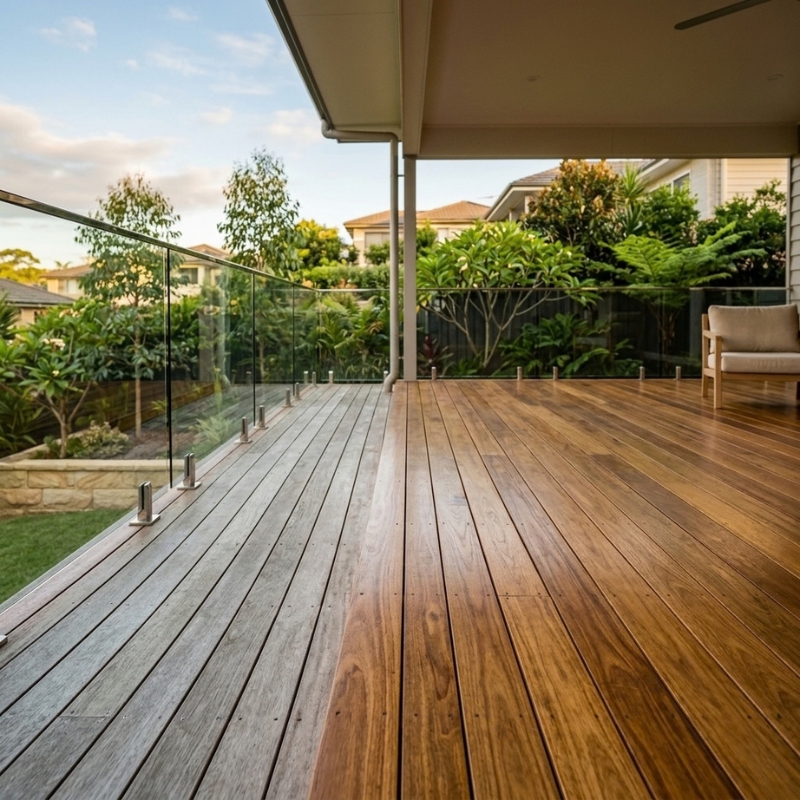
How often does exterior timber need re-varnishing? Fully exposed timber, like a north-facing deck or an open handrail, usually needs re-coating every one to two years, while sheltered timber can go considerably longer. So the honest answer is that there is no single figure, only ranges set by how much weather the timber takes. Exposure is the variable that matters most. MI Painting handles exterior timber varnishing for homes and common property across Sydney, and this is one of the questions we are asked most, usually by someone whose deck or door has started to look tired and grey. This article covers the typical intervals by exposure, what Sydney conditions do to a coating, the signs yours is due, and whether you can re-coat or need to strip back to bare timber.
How often does exterior timber need re-varnishing? Fully exposed timber such as a north-facing deck or handrail usually needs re-coating every one to two years. Sheltered timber such as a covered front door can often go three to four years before the coating dulls or stops beading water.
What are the typical re-coating intervals by exposure?
The single biggest factor in how often timber needs re-varnishing is how exposed it is, so the useful way to think about it is by position rather than by a blanket figure. Here is the general picture.
| Timber and position | Typical re-coat interval |
| A north-facing deck or fully exposed handrail | Every one to two years |
| A sheltered, covered front door or protected timber | Often three to four years |
| A coastal handrail or exposed timber near the sea | At the shorter end, around every year or sooner |
A north-facing deck cops the most sun of any orientation in Australia, and being underfoot and open to the rain as well, it works its coating hard, so it sits at the short end of the range. A sheltered front door under a porch or eave is protected from both the direct sun and the rain, so its coating lasts far longer before it dulls or stops shedding water. A coastal handrail has the sun and rain plus salt to contend with, which pushes it to the most frequent end.
These are general ranges rather than a figure for your exact timber, since the real interval depends on the specific position, the timber and the coating. Professional timber varnishing services can judge the right cycle for your timber once they have seen how exposed it is.
What do Sydney conditions do to an exterior coating?
Understanding what actually breaks a coating down explains why exposed timber needs re-doing so much sooner than sheltered timber. Three things do most of the damage in Sydney.
UV breakdown is the main one. The sun’s ultraviolet light steadily degrades a coating, breaking down the finish and, once it gets through, greying the timber beneath. This is why a north-facing, sun-drenched surface fails fastest, and why the same timber in the shade lasts far longer.
Moisture movement in the timber is the second. Timber absorbs moisture when it is wet and gives it off as it dries, so it swells and shrinks with the weather. That constant movement stresses the coating on top of it, working it loose over time, particularly at joints and edges where the movement is greatest.
Salt is the coastal factor. Near the sea, salt-laden air settles on the timber and accelerates the breakdown of the coating, which is why coastal timber needs more frequent attention than the same timber inland.
Together these explain the intervals above: the more sun, moisture cycling and salt a piece of timber sees, the faster its coating is spent, which is simply another way of saying exposure sets the timeline.
What are the signs a coating is due?
Rather than counting the years, it is better to read the timber itself, because it shows clear signs when the coating is wearing out. Watch for these:
- Dullness. A fresh coating has a sheen, and as it ages that sheen fades, so a surface that has gone flat and lifeless is telling you the finish is wearing thin.
- A chalky surface. The coating can break down into a fine powdery film on the surface, which is a clear sign it has weathered and is degrading.
- Water no longer beading. On a sound coating, water sits up in beads on the surface. When water starts soaking in or spreading flat instead of beading, the coating has lost its ability to repel moisture, which is one of the most reliable signs it is due.
- Greying at edges. When the timber itself starts turning grey, especially at edges and corners, the coating has failed there and the UV is reaching the bare wood.
- Lifting at end grain. The cut ends of timber, the end grain, are the most absorbent part, and a coating lifting or failing there is often the first place the whole finish starts to go.
The water-beading test is the quickest and most telling: splash a little water on and see whether it beads or soaks in. If it soaks in, the timber is no longer protected and a re-coat is due, ideally before the greying sets in and turns a re-coat into a strip-back.
Should you re-coat or strip back?
When the time comes, the next question is how much work it needs, and that depends on what state the existing coating and timber are in. There are two paths.
A light sand and re-coat is enough when the coating has simply worn thin but is otherwise sound and still bonded, and the timber underneath has not greyed or degraded. You scuff the surface to give the new coat something to grip, clean it, and apply fresh coats over the top. This is the easier path, and it is exactly why catching the timber early, before the signs above become severe, saves work. A coating caught at the dulling-and-not-beading stage usually only needs this.
A strip back to bare timber becomes necessary when the coating has failed more seriously, when it is lifting, flaking or breaking down across the surface, or when the timber beneath has greyed and weathered. At that point you cannot just coat over the damage, because the new coat would only be as sound as the failed surface under it. The old coating has to come off and the greyed timber has to be brought back to sound, clean wood before anything new goes on.
The lesson is that the longer timber is left past due, the more likely it tips from an easy re-coat into a full strip-back, which is more work for the same result.
What preparation makes the next coat last?
How long the next coat lasts is decided as much by the preparation as by the coating itself, so it is worth doing properly. The key steps are:
Cleaning the timber thoroughly first, removing dirt, grime and any growth, because a new coat will not bond well over a dirty surface.
Drying time matters more than people expect. Timber has to be properly dry before coating, since any moisture trapped under a new coat causes it to fail early, so the timber needs time to dry out after cleaning or rain before anything goes on.
Sanding grit progression means working through the sandpaper grits in order, from coarser to finer, rather than jumping straight to fine or staying too coarse. This gives a smooth, even surface that the coating keys to properly.
Sealing end grain is the detail that is easy to skip and costly to miss. The cut ends of timber soak up moisture far faster than the faces, so sealing the end grain well is what stops water getting in there and lifting the coating from the ends, which is where failure so often starts.
Good preparation is unglamorous but it is the difference between a coating that lasts its full interval and one that fails early, which is why it is worth getting right rather than rushing to the fun part of brushing on the finish.
Frequently Asked Questions
When should you re-varnish outdoor timber?
The best guide to when to re-varnish outdoor timber is the timber itself rather than a set date. Re-coat when the finish has dulled, gone chalky, or water no longer beads on the surface, and ideally before the timber starts greying, since greyed timber usually needs stripping back first.
How long does exterior timber varnish last?
As a general guide to exterior wood coating lifespan, fully exposed timber such as a north-facing deck often needs re-coating every one to two years, while sheltered timber can last three to four. Coastal timber sits at the shorter end, since salt adds to the sun and moisture.
What does timber varnish maintenance involve?
Timber varnish maintenance is mostly keeping the timber clean, checking whether water still beads, and re-coating before the finish fails. Caught early, a light sand and fresh coats are enough, whereas timber left until it greys usually needs stripping back to bare wood first.
Keeping your timber protected
The sensible approach is to judge your timber by its exposure and its condition rather than a fixed date: check whether water still beads, watch for dulling and greying, and re-coat before the finish fails so you stay on the easy side of a light sand rather than a full strip-back. Timber looked after on a sensible cycle stays protected and keeps its look for years. If you would like your timber assessed and re-coated properly, or you are refreshing the exterior more broadly with exterior painting services in Sydney, get in touch to talk to the team about timber work across Sydney.

