
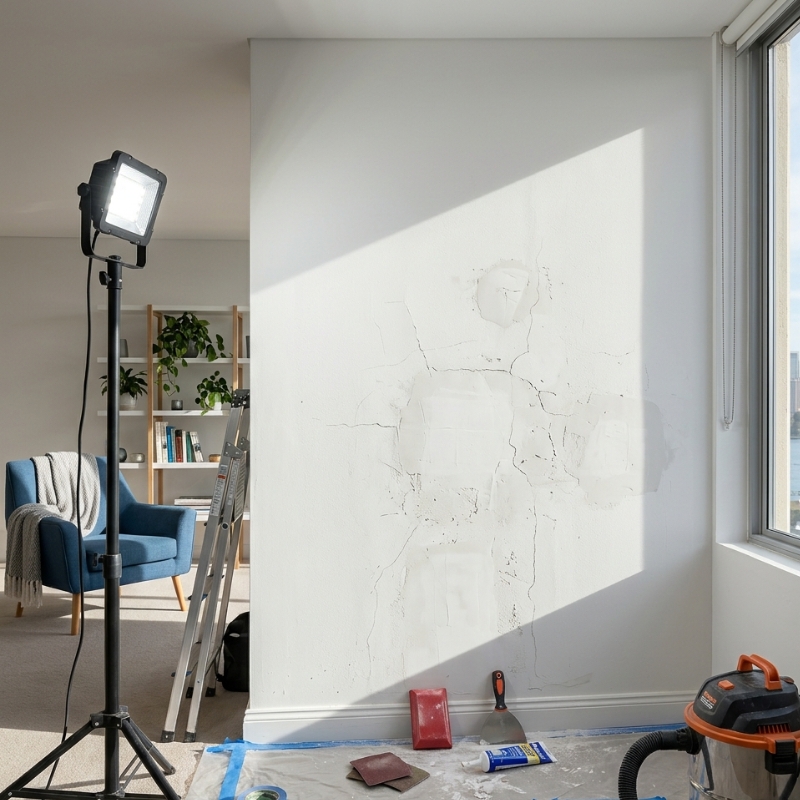
A great paint job is mostly preparation. If your walls need plastering to fix even small dents, or if there’s dust, grease, glossy patches, water stains, or hairline cracks, paint will highlight them—especially in Sydney homes where bright daylight, downlights and humidity can make imperfections stand out.
Below is a practical, step-by-step checklist you can follow room by room. It’s written for real conditions: older terraces and semis, newer builds with strong raking light, coastal suburbs with salty air, and bathrooms and laundries that cop steam year-round.
Before you start: the 2-minute wall assessment
Walk the room with:
• A bright torch (or your phone torch)
• A pencil
• A clean, dry hand
Shine the light along the wall at a shallow angle. This “raking light” shows dents, ridges, and patch edges that disappear in normal lighting. Circle problems lightly in pencil so you don’t lose them later.
Also, do a quick touch test:
• If the wall feels dusty or chalky, paint won’t bond well until it’s cleaned and stabilised
• If it feels greasy (common near cooktops or light switches), you’ll need a degreasing wash
• If it feels damp or smells musty, stop and work out the moisture issue before painting
Q: What’s the biggest reason paint looks rough or uneven?
Most of the time, it’s one of these:
• Dust left on the wall after sanding
• Unfeathered patch edges (you can feel them with your fingertips)
• Painting over gloss without scuff-sanding
• Skipping primer on repairs so patches “flash” through the finish
Step-by-step wall preparation checklist
Step 1: Move, cover, and protect (the mess-free setup)
Do this first, so you don’t rush later:
• Move furniture to the centre of the room and cover with drop sheets
• Use floor protection that won’t slip (especially on timber floors)
• Remove wall plates (power points/switches) where safe to do so
• Remove hooks and picture nails; keep hardware in a labelled bag
• Tape off edges only after cleaning and sanding (tape sticks better to clean surfaces)
Sydney tip: If you’re painting during a humid week (common late summer and after rain), plan for longer drying times for fillers and primers. Ventilation matters more than you think.
Step 2: Fix moisture, mould, and stains first (don’t paint over symptoms)
Paint is not a moisture solution. If you paint over active moisture, you often get bubbling, peeling, or brown stains bleeding back through.
Look for:
• Bubbling paint, soft plaster, or a “tide mark” on the wall
• Black spotting in corners or on bathroom ceilings
• Yellow/brown water staining near downpipes, windows, or roof lines
If you suspect older paint is present, and you’re sanding or scraping, use lead-safe methods. NSW guidance covers safer approaches to renovation prep, including dust control and wet methods. Use this as your safety reference: NSW LeadSmart renovation guidance.
Q: Can I just paint over mould if I use a “mould-resistant” paint?
If mould is active, painting over it rarely works long-term. Clean and treat the area properly, improve ventilation, and make sure the substrate is dry before repainting. Otherwise, it comes back through the coating.
Step 3: Clean the walls properly (the step most people rush)
Even “clean-looking” walls collect invisible grime—cooking oils, handprints, airborne dust, and bathroom residue. Cleaning improves adhesion and helps your paint lay flatter.
What to do:
• Dust first (dry microfibre cloth or a soft broom)
• Wash with a wall cleaner or sugar soap alternative as directed
• Focus on: kitchens, around switches, hallways, kids’ rooms, and near vents
• Rinse with clean water if the product requires it
• Let walls fully dry
Sydney tip: In coastal areas (e.g., Eastern Suburbs, Northern Beaches), salty air can leave residue on surfaces and contribute to adhesion issues. A proper wash is worth it.
Step 4: Scrape and remove anything that’s loose
Paint will only be as strong as what it’s stuck to.
Check for:
• Flaking paint
• Blisters
• Crumbly filler
• Loose caulk along trims
Action:
• Scrape back to a firm edge
• If edges are ragged, lightly sand to smooth transitions
• Remove all dust after (don’t rely on “paint will cover it”)
Step 5: Repair dents, cracks, and holes (and know when a patch isn’t enough)
Small repairs are normal prep. But if you’ve got repeated cracks, soft areas, or widespread movement, you may need more than filler.
For typical nail holes and minor dents:
• Use an appropriate wall filler
• Apply in thin layers (thick blobs shrink and crack)
• Slightly overfill so you can sand flush later
• Respect drying times—rushing causes sink marks
For hairline cracks:
• Open the crack slightly (enough to remove loose material)
• Fill, then feather wide so the repair disappears
• If cracks reappear in the same spot, that’s a sign of movement or a deeper issue
If you’ve got damaged sections, blown areas, or multiple repairs across a wall, you may be better off addressing the substrate first (rather than chasing problems with paint). This is where plaster repairs in Sydney can be the sensible next step—because a stable, smooth base is what paint needs.
Q: How do I know if a crack is “normal” or a red flag?
A single fine hairline crack that doesn’t change can be common. Red flags include:
• Cracks that keep returning after patching
• Multiple cracks radiating from doors/windows
• Soft or hollow-sounding areas
• Staining or dampness around the crack
If you see these, treat them as a wall issue first, then paint.
Step 6: Sand like you mean it (smooth walls are made here)
Sanding does two jobs:
• It levels patching, so it disappears
• It gives paint something to grip, especially on glossy or hard surfaces
A simple approach:
• Sand repairs first to flatten and feather edges
• Then do a light sand across the whole wall if the surface is rough or glossy
• Run your hand across the wall—your fingers find what your eyes miss
Common sanding mistakes:
• Sanding only the patch centre, leaving a “halo” edge
• Using too coarse a grit and leaving scratches that show through paint
• Not controlling dust (dust = gritty paint finish)
Sydney tip: If your home gets strong afternoon sun across a wall, that raking light will reveal even tiny ridges. Aim for a wide feather—bigger than you think you need.
Step 7: Remove sanding dust (this is non-negotiable)
If you do nothing else “extra,” do this. Dust is the enemy of a smooth finish.
Do this sequence:
• Vacuum walls with a soft brush attachment (especially along skirtings and corners)
• Wipe with a slightly damp microfibre cloth to pick up fine dust
• Let the wall dry before priming or painting
Q: Why did my paint dry with little bumps?
It’s usually dust—either left on the wall, falling from ceilings/cornices, or stirred up from floors while painting. Dust control is a finish-quality step, not a “nice to have.”
Step 8: Spot-prime repairs and treat stains (prevent flashing and bleed-through)
Fresh filler and patched areas absorb paint differently from surrounding surfaces. If you paint straight over them, you can get:
• Dull patch shapes visible through the finish (“flashing”)
• Uneven sheen under lights
• Stains reappearing
What to do:
• Spot-prime all repairs once they’re sanded smooth and dust-free
• Use a stain-blocking primer for water marks, smoke staining, or persistent discolouration
• Let primer dry fully before topcoats
If you’re dealing with widespread wall issues—multiple patched zones, uneven surfaces, recurring cracks—painting alone won’t “hide” it reliably. In that situation, how to fix damaged walls before painting becomes the real question to solve first.
Step 9: Caulk gaps for a cleaner finish (optional but noticeable)
Caulking makes edges look crisp, especially around:
• Architraves and skirting boards
• Cornices
• Built-ins and trim joins
Key points:
• Only caulk gaps that should be sealed (not drainage gaps)
• Smooth the bead neatly
• Allow proper cure time before painting
Step 10: Mask smart, not hard (and don’t rely on tape to fix messy edges)
Tape is best for:
• Protecting trims you’re not painting
• Keeping lines crisp on feature walls
• Reducing clean-up time
Tape is not a substitute for:
• Cleaning
• Sanding
• A straight cut line with good technique
Pro tip: Press tape edges firmly and remove tape while paint is still slightly tacky to reduce peeling.
Step 11: Final “torch test” before paint
Do one more torch pass along the wall. Fix anything you can:
• Small ridges: light sand + dust wipe
• Pinholes: quick skim of filler + sand
• Patch edge: feather wider
This last check is often the difference between “looks fine” and “looks professional.”
If you’re chasing smoothness on a wall that’s been repaired multiple times or has uneven texture, the fastest path to a better finish is often to address the substrate properly first—this is where you can repair cracks and dents before painting rather than layering paint over problems.
Room-by-room prep notes (Sydney reality check)
Kitchens
• Degrease thoroughly (around cooktops and splashback zones)
• Expect more adhesion issues if you skip washing
• Prime stained areas to prevent bleed-through
Bathrooms and laundries
• Fix ventilation first (exhaust fans, airflow)
• Treat mould properly and allow full drying
• Use appropriate primers on stained or previously peeling areas
Bedrooms and living areas
• Focus on torch-checking for dents and patch halos
• Dust control is the biggest finish upgrade
• Spot-prime all repairs to prevent sheen differences
Common prep mistakes that ruin the finish
• Painting over dust (gritty texture)
• Skipping spot-priming (patches show through)
• Painting over damp substrates (bubbling/peeling)
• Not scuff-sanding glossy surfaces (poor adhesion)
• Rushing drying times (sink marks, cracking filler)
• Underestimating how much light reveals (especially downlights)
FAQ: Wall preparation before painting
How clean do walls need to be before painting?
Clean enough that water no longer beads on oily areas, and your cloth doesn’t pick up grime. If you can rub your hand on the wall and it comes away dusty or greasy, paint prep isn’t done yet.
What grit sandpaper should I use for wall prep?
It depends on the surface and what you’re sanding (patch vs whole wall). The goal is a flat, feathered repair with no noticeable edge and no deep scratch marks. If you can see scratches clearly, it’s too aggressive for a final finish.
Do I need primer on every wall?
Not always. You generally need primer for:
• Fresh patches and fillers (spot priming)
• Stained areas (stain-blocking primer)
• Chalky/porous surfaces
• Big colour changes or uneven substrates
If you skip primer where it’s needed, you often see it in the final sheen.
Why do patches show through after painting?
Because patched areas absorb paint differently and reflect light differently. Spot-priming repairs, feathering wider, and sanding smooth are the fixes.
Can I paint over old glossy paint?
You can, but you’ll typically need to scuff-sand (and clean) so the new coating bonds properly. Glossy surfaces are one of the most common adhesion failures when prep is rushed.
How long should filler dry before sanding and painting?
Follow the product directions and consider conditions. In humid Sydney weather, drying often takes longer—especially for deeper fills and areas with less airflow.
What if my wall keeps cracking in the same place?
That’s often movement or a deeper substrate issue, not just a surface flaw. Repeated patching without addressing the cause usually leads to repeat cracks.
What should I do about water stains?
Identify and fix the moisture source first, let the wall dry, then use the right primer to prevent stain bleed-through. Painting straight over stains without prep often fails.

